Into December
Like many, we did not go anywhere for Thanksgiving. Nevertheless, we enjoyed good food and used that time to count our blessings and note the things for which we are grateful.
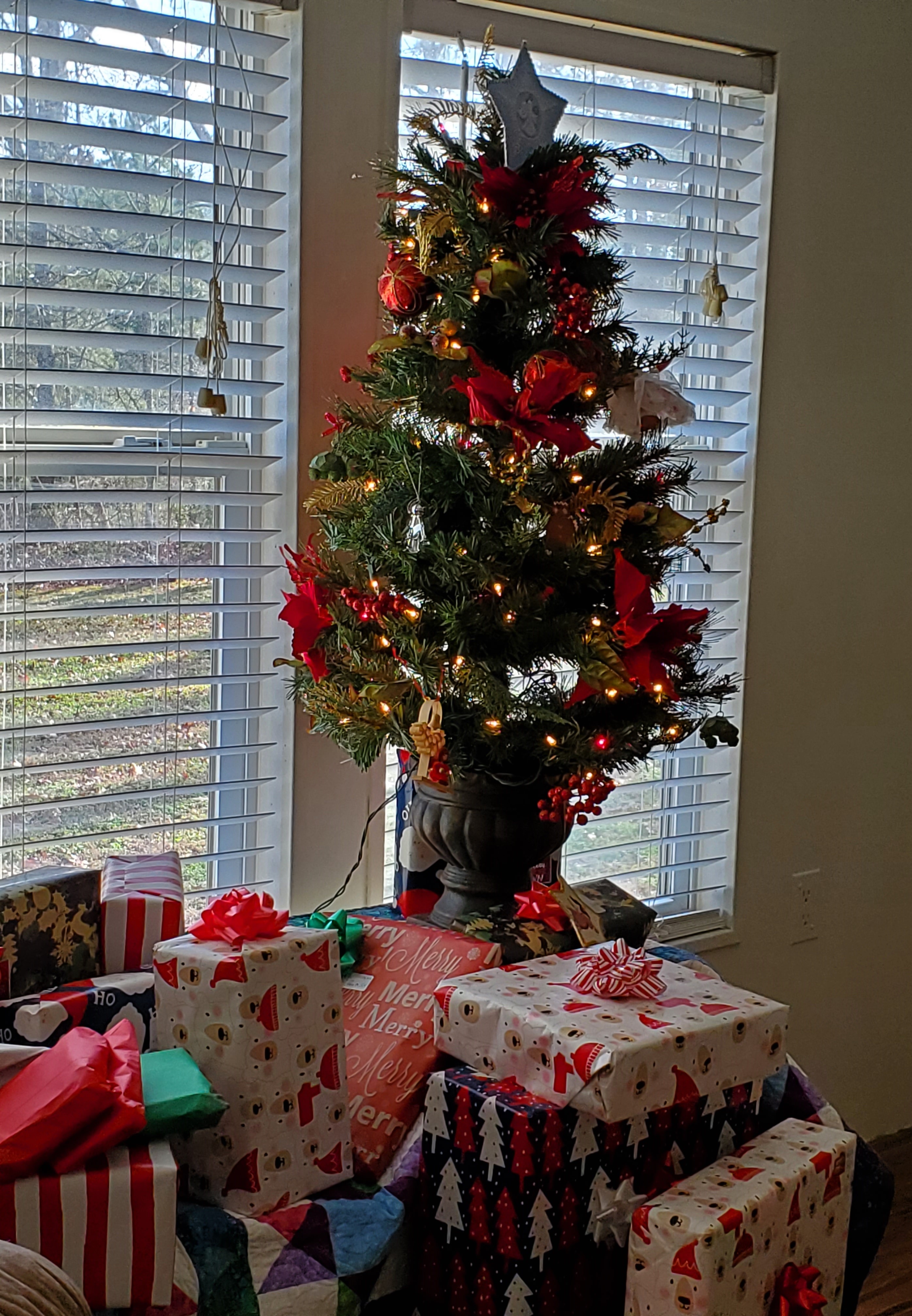
We also will not gather for Christmas. Just because we can’t do what we usually do during the holiday season, however, it does not mean we are leaving it unobserved. Christmas presents have been purchased and wrapped. The Christmas tree has been decorated, food has been purchased. My daughters and I have talked about how the three households can “gather” virtually and enjoy unwrapping presents together – that will be a new thing for us. We may not be observing all of our usual traditions but we can find joy in the season if we look for it, or make it. I even got a few days scheduled off from work so I can enjoy a slower pace this month.
The chickens keep us busy each weekend. Last weekend we moved the roosters’ coop to a new patch of grass and, this weekend, we moved the chunnel for the big coop. We have chicken TV outside the dining room window again!

We recently let the chickens out of their coop a few times. I was completely surprised when we first let Roadrunner and Thunderbutt (the two Blue Belle roosters) out and they immediately started fighting each other. They flashed a full display of feathers and feet and just railed on each other until they figured out how to stay out of each other’s way. The next day, when we let Blondie and Dotty (the two Legbar roosters who had separated from the flock when they got sick), they too immediately began fighting. I looked at them and said, “Well, I guess they’re not as sick as they pretend.” Today, the hens got to get out by themselves. They certainly enjoy have free-range time. I hope to get fencing up by next summer so they can free-range for longer periods without wandering into the neighbors yard.
I visit and talk to the apple trees each weekend. They seem to still be alive.
🎄
Trees as a Test of Faith
One of the things I’ve tried to get on my property since moving here is apple trees. This year, that project came back to the forefront when I found fastgrowingtrees.com. The trees from this grower have advanced root systems so that you get apples the first or second year instead of waiting 5 – 10 years for a tree to begin bearing fruit. They had both Granny Smith and Golden Delicious dwarf varieties, which are my favorite combination to use when making applesauce.
Unfortunately, you pay for the extra-developed root system: they were $100 each. That caused me to hesitate and by the time I decided I would get just the Granny Smith this year and a Golden Delicious the next year, they were sold out of both. (It was okay to get just one tree at a time because those two varieties are self-pollinating).
On to Plan B.
I ordered trees from a local grower. I got a Golden Grimes (sweet), which is a parent of the Golden Delicious and a Mary Reid (tart) which is a locally-developed apple. They were semi-dwarf instead of the dwarf that I would have preferred but they only cost $25 each.
I did some research and found that you can grow semi-dwarf trees in pots. Doing so would help them develop and produce faster than they would in the ground (3-5 years to harvest, rather than 5-10 years). So, rather than dig a hole in the nasty clay soil I have and then amend the soil to make it the right Ph, with the right levels of nutrients, I got 15 gallon pots, some ready-made tree soil, some peat moss, and some rocks for the bottom layer to provide drainage.
When the trees arrived, everything was ready to go. They got planted in their pots and placed in what seems to be the right areas of the yard. If not, I put a rubber mat (with built-in drainage channels) under each pot to keep them off the ground and make them more moveable.
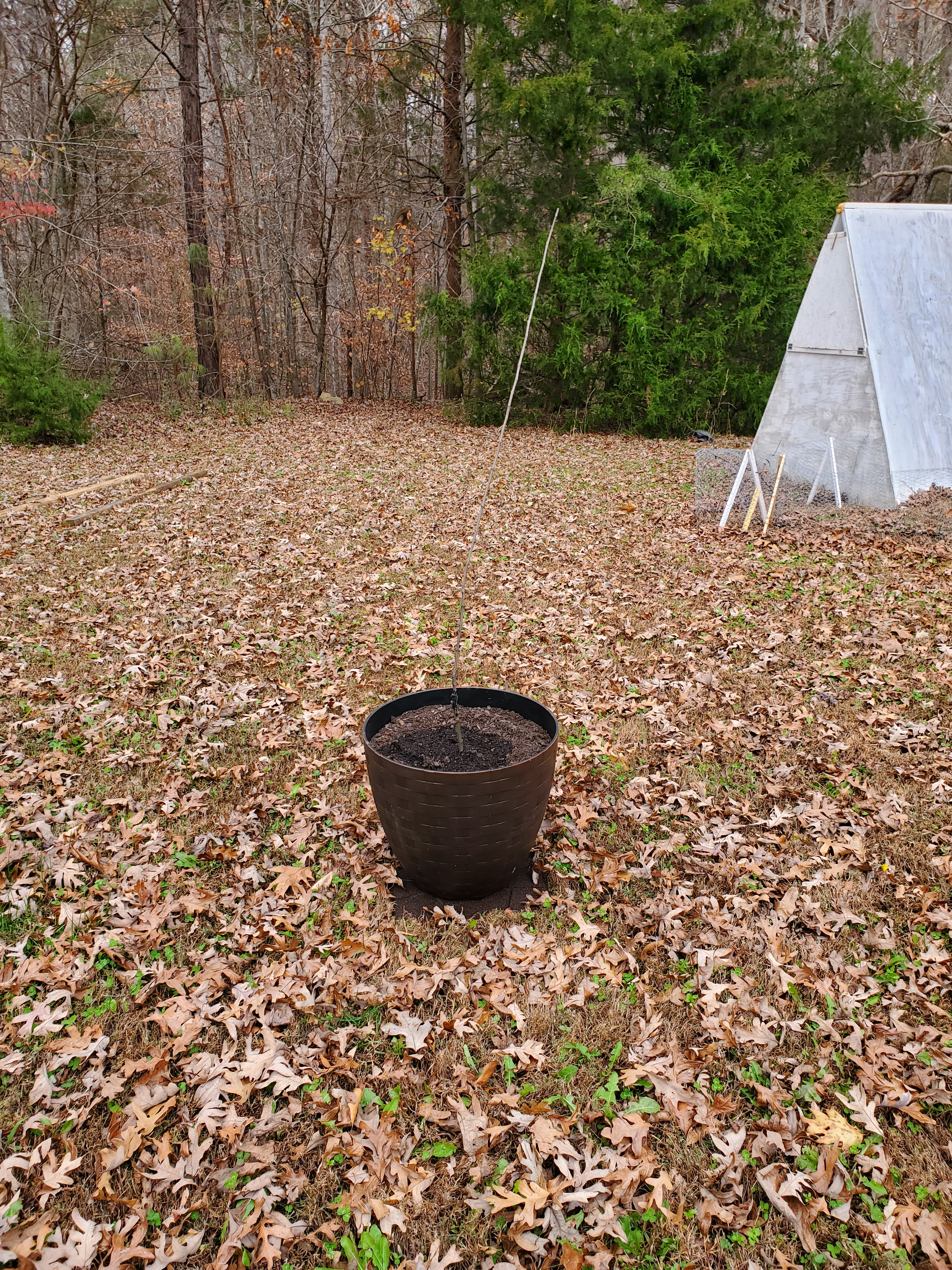
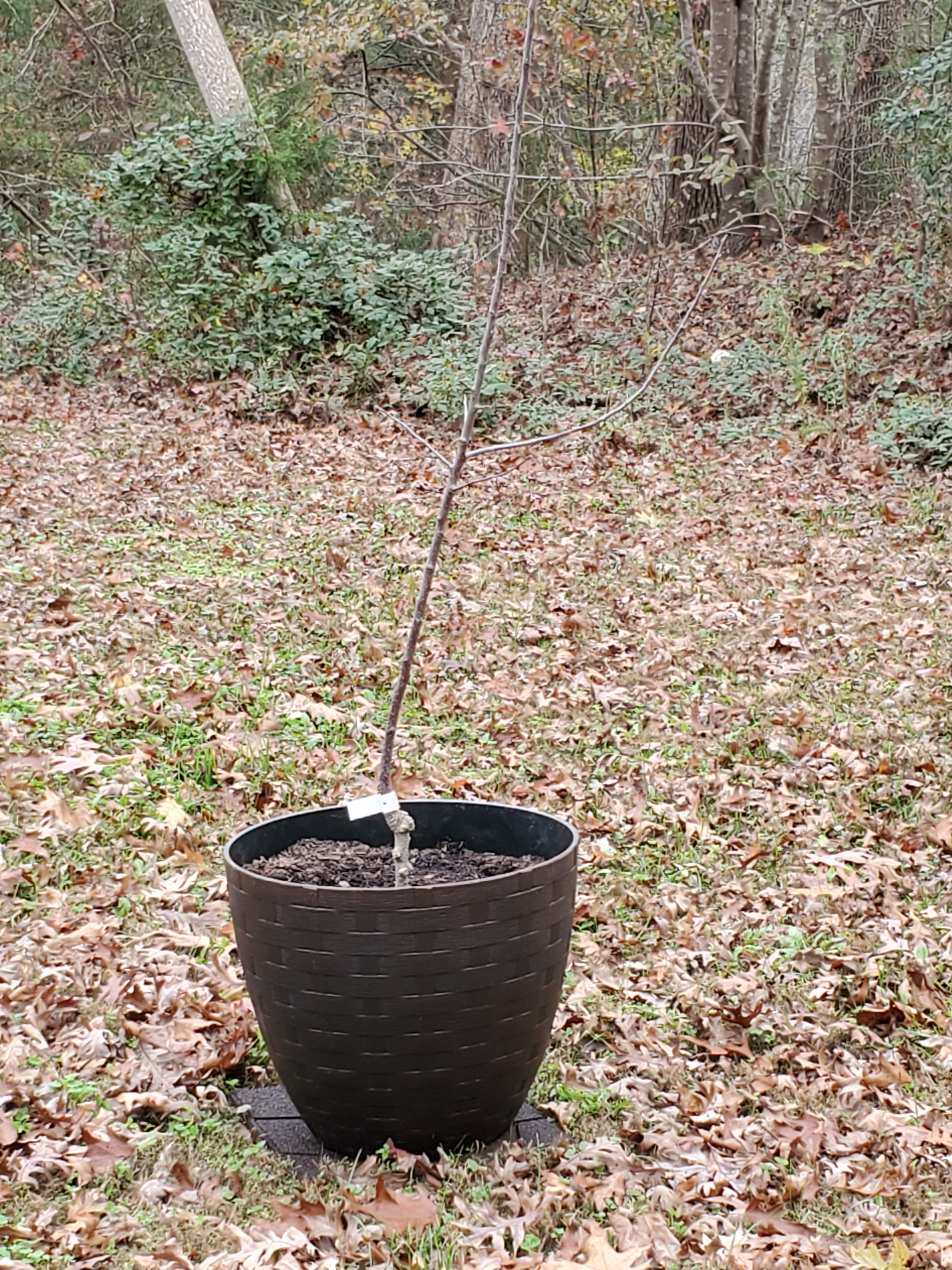
That’s my newest enterprise. I must admit, this one feels more like a trial of faith than an adventure. That’s because they look like sticks. I can’t tell if the sticks are alive or dead. It’s going to be several months before they will show any sign that they are alive. So, we wait.
Presenting, Stick #1 and Stick #2:
And then there were FOUR
If you’ve followed along the last 5 months, you know that I have seven chickens, three roosters and four hens, in two coops. There are 5 chickens in main coop, aka the Crookedest Chicken House in the East. The second, small, coop is for the two Cream Legbar roosters that got Marek’s Disease but didn’t die. That’s three roosters out of the seven eggs we hatched.
Wait, did I say three roosters? Well, it appears we have a changeling.
Until a couple of weeks ago, Road Runner was the obvious rooster in the main coop. He was bigger than the other chickens, had a big, colorful comb, a beautiful cape of black feathers around his hackles, and a rooster tail. Until a couple of weeks ago, Thunderbutt looked just like Eager with a small, almost non-existent black comb and a smaller body. That all changed though. I noticed Thunderbutt’s comb was getting bigger and redder. Then I noticed Thunderbutt was getting bigger and was developing a cape of black feathers around the hackles and a big rooster tail. Thunderbutt has not crowed but, by golly, Thunderbutt is a rooster!
Sigh, I need another chicken coop to move these two Laced Blue Belle roosters into (two roosters is too many for 3 hens). Either that or I’m going to have to hitch up my big girl pants and learn how to process chickens for freezer camp.
In the main coop:

Caboose 1 – Cream Legbar hen 
Caboose 2 – Cream Leg Bar hen 
Eager – Laced Blue Belle hen 
Road Runner – Laced Blue Belle rooster 
Thunderbutt – Laced Blue Belle hen turned rooster


In the little coop:

Blondie – Cream Legbar rooster 
Dotty – Cream Legbar rooster


Bleck!
Well, that didn’t go well.
This week’s experiment was to make fermented chicken feed. Of the many expectations touted, I was most interested in three: it was healthier for the chickens, it was money-saving, and it was easy to do.
It looked like it was working. It sat on my counter. It bubbled. I stirred it every day. At the end of four days, though, about the only positive thing I can say with this first attempt (it’s unknown if there will be anther try) is that it was entertaining.
D-day came and, as I was in a hurry to leave for work, I asked Oscar to pour off the excess water and split it between two dishes.
I came into the living room to find Oscar deep breathing. Me: “What’s wrong with you?” O: “I can’t.” Me: “Nonsense.” He finished the job but it included a lot of this from him – while I laughed hysterically.
The roosters in the front yard avoided their dish for a couple of days and when they finally ate some, scrubbed out their mouths. The chickens in the coop did eat theirs, I think.
I do not know what the future of fermented feed is for my household. I’ll have to cogitate on it for awhile.
Categories of Preparedness
Since I obviously need a review of what I learned previously about being prepared, I am just going to re-post some basics.
Often when discussing preparedness or provident living, people think Food Storage or Emergency Kits and that’s all they work on. Within the three Priorities of Preparedness, there are several categories to consider when preparing a household to survive the various emergencies / disasters that can come along. These include:
Emergency Kits
Food Storage
Water Storage
Communications
Shelter
Sanitation
Medical
Safety
Spiritual / Emotional / Mental
Community
Knowledge / Skills
Consideration also needs to be made for short-term and long-term options and mobile and static options (Bug Out vs Shelter in Place) for each category.
Short-term vs. long-term: most emergencies last a relatively short period of time, but not all. A good example of this is, when working on your food storage, start with a three-month supply of everyday, grocery-store type foods but then add long-lasting food like rice, wheat, powdered milk, etc. to take care of your family for a year. After that you can make plans for a garden, an orchard, whatever you are able to do to make your household more self-reliant.
Static vs. mobile: different emergencies will require you to shelter in place and some to leave your home. The needs for each scenario are different. For example, the recent pandemic lockdown required people to stay in their homes, but, when Hurricane Florence was predicted to hit my area, I re-located to my daughter’s home further inland. (Ironically, that storm changed course and swung down and around leaving my area alone but causing damage further west – right where I had gone for safety!).
This looks like a lot, doesn’t it? It’s important to remember though, if all you can do for now is keep a few weeks worth of food in your pantry, or a couple hundred dollars in your emergency fund, that’s fine. Don’t stress, it doesn’t mean you are inadequate when you are doing the best you can within your circumstances. Just keep moving: a step at a time, is still moving forward.
🙂
Next Experiment: Fermented Feed
Whether it’s yogurt or sauerkraut or sourdough or cod liver oil, fermented foods are good for human health. Apparently, fermentation is good for chickens, too.
Here’s what I found about the benefits of fermented chicken feed.
- It increases the digestibility and nutrient absorption. The protein usage increases by 12% and it enhances the content of certain vitamins.
- It improves gut health and strengthens the immunity. It makes the chickens more resistant to e. coli, salmonella, flagella, and coccidia and increases parasite resistance.
- Less food is consumed because of the increased nutrient absorption and the food itself doubles in size when fermented. Chickens go through a Lot of chicken food so decreasing the food bill is a definite boon.
- They lay better quality eggs. My hens haven’t started laying so I won’t be able to verify this one but all reports indicate giving chickens fermented food will result in increased yolk size, increased egg weight, increased rate of laying, better flavor, and thicker egg shells.
- A much improved end result – chicken poop. With less undigested matter in the feces there is less nitrogen in the manure, less smell, fewer flies, and less ammonia. Not only that but their stools are more solid and they poop less. How great is that?!
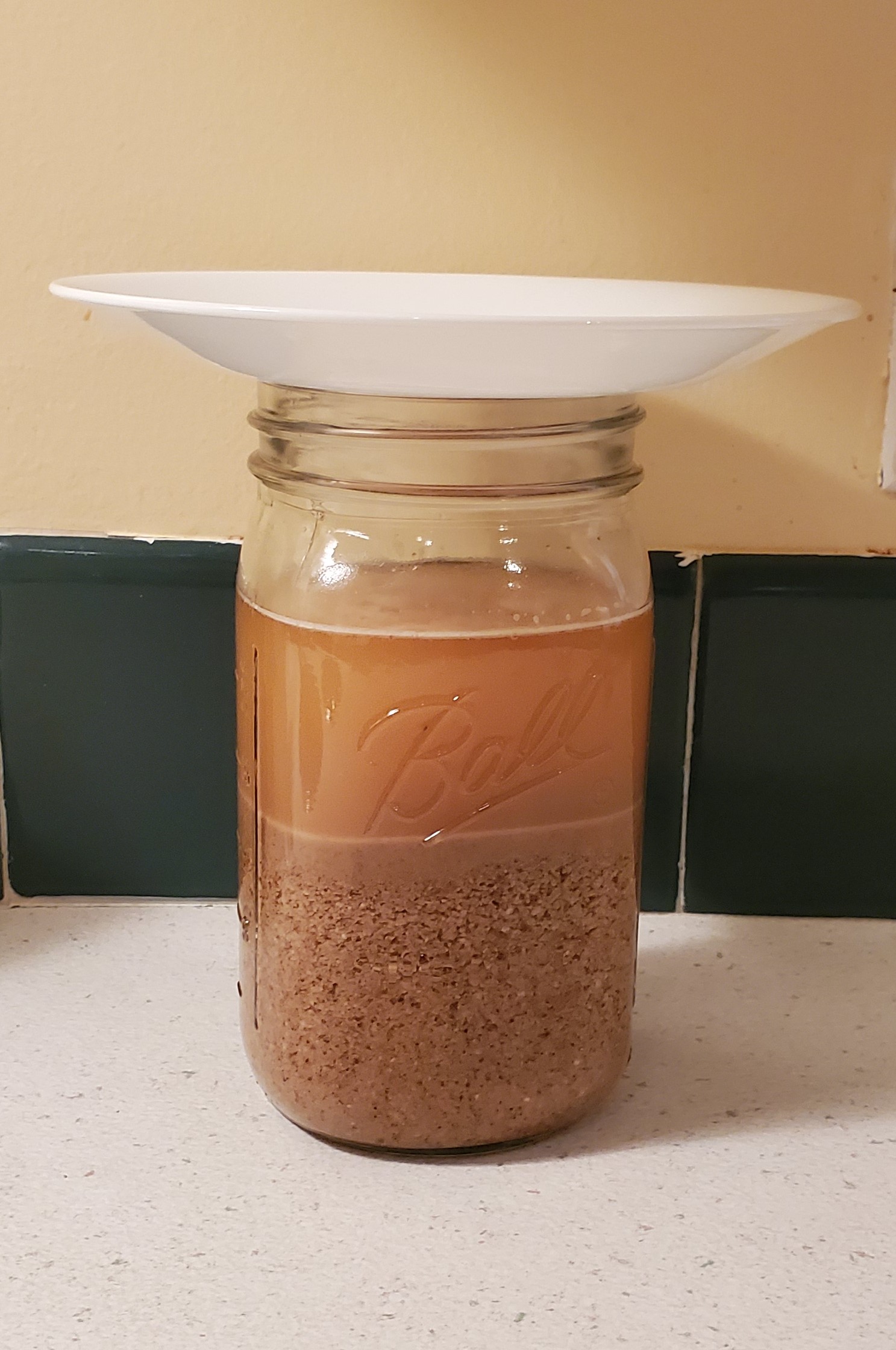
It seems to be an uncomplicated process. Not as easy as just pouring crumbles into the feeder but pretty close. Put the food in a jar, cover it with enough water to give it room to expand, put a plate or towel over the top, let it sit on the counter for 3 or 4 days, stir daily, add more water if needed.
It appears there’s nothing to lose so, I started my first jar today.
😊
No One Can Do it All
One of the most useful discoveries I’ve made in my journey toward self reliance is that I can’t do it all but every little bit I can do or learn will make a big difference. As long as I continue to put one foot in front of the other, I am succeeding.

Priorities of Preparedness
A week or so ago, I mentioned I had been wrestling with what to work on to bring my lapsed preparedness efforts up to snuff. We are in a bad patch in this country. The past several months have been filled with societal and economic upheaval, with shortages and hoarding, with people filled with anger, anxiety, and frustration, and with lots of idiocy. There are so many things to do and only limited resources, so I found myself flitting from one thing to another and making what I thought was very little progress.
To calm my mind, I reviewed some of my previous blog posts to refresh my focus. The first thing I found was that I’m doing fine. Yes, there are lots of things to do across several categories, and, yes, I don’t have the resources to move as quickly as I would like, but I was reminded to just do a little in each area (perhaps a little more in categories that are sorely behind) and I will be blessed for having done the best I can with I have.
I also found this diagram of the overall preparedness effort:

It reminds me that getting prepared is not all about buying stuff. When you’ve used up your budget for Supplies expenditures, you can still work on the areas of Planning and Training.
Every step is progress.
🙂
A New Home
After I noticed the roosters getting better, I started looking for a more permanent shelter to build for them. A rabbit cage with a tarp to provide protection from the weather was fine when we were just waiting for them to die but certainly won’t work for winter weather, even in North Carolina.
I found a kit that would not require the roosters to do any climbing when they go between the coop and run and ordered it – the day before The Great Rooster Escape. (Wasn’t that fortuitous?)
A kit works for this purpose because I need to house only for two, not seven chickens. Since the chicken craze we were seeing during the pandemic lockdown has died down, not only was it not outrageously priced like kits were in the Spring and Summer, but it was on sale. I found an additional coupon to apply, too!
So the major project for today (Saturday) was to assemble the kit and move the roosters. It was really easy! Oscar put it together in about 20 minutes, without any assistance from me.
Ta – Da!
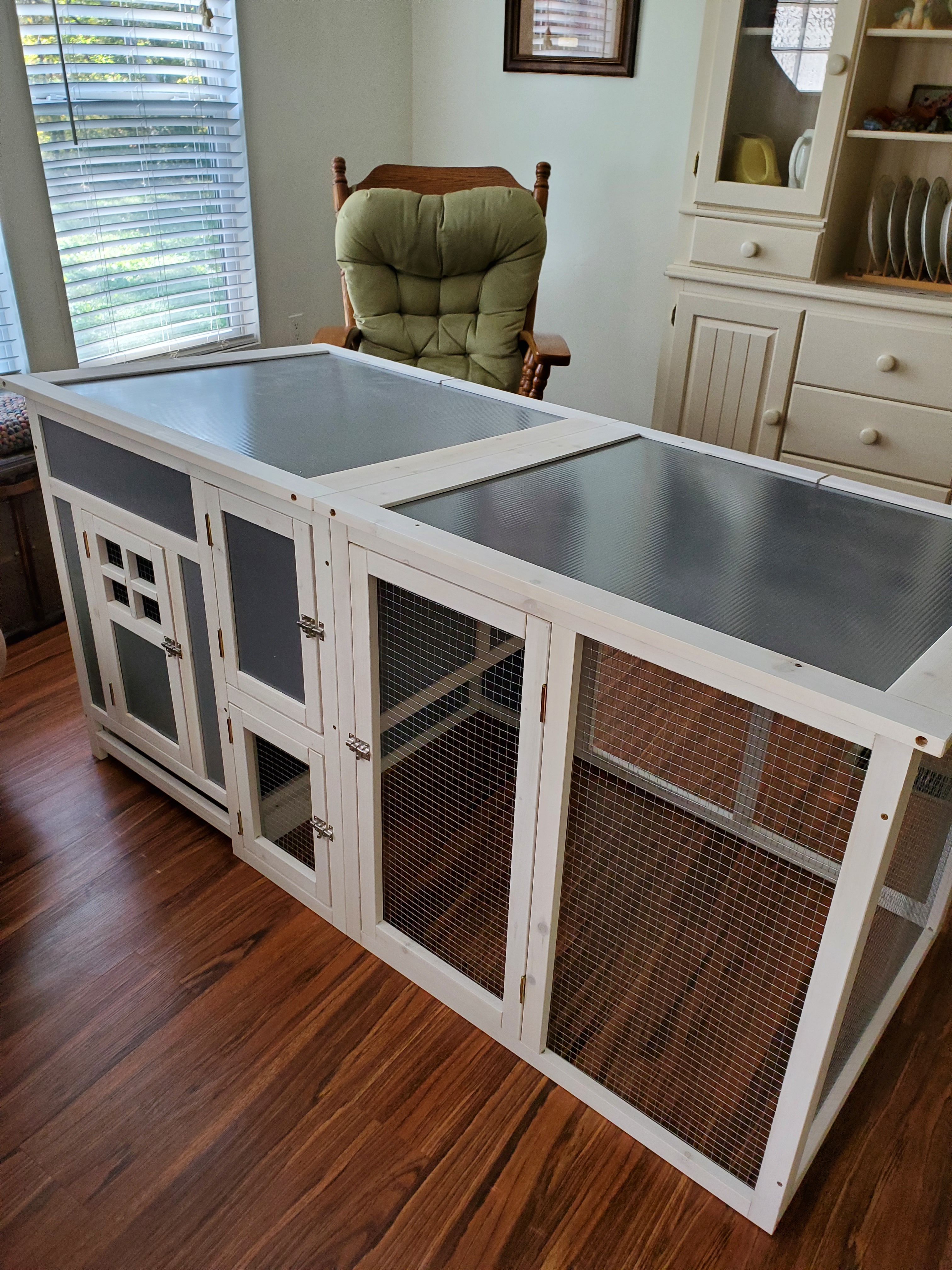
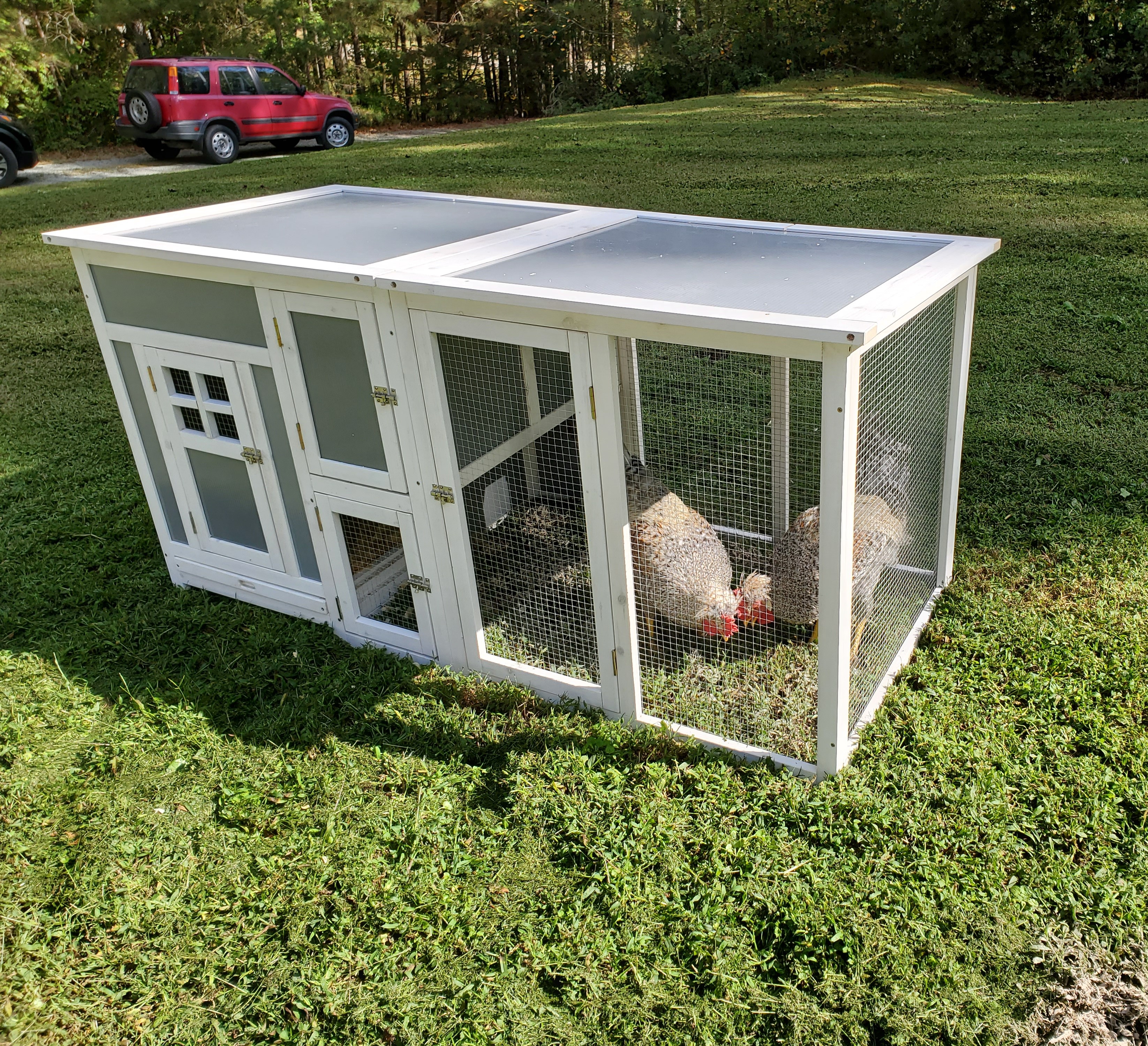
We put it in the front yard. The main coop is in the back yard. When the two groups could see each other, they wanted to be together. I think it will be easier on both groups if they don’t see each other. We’ll see if that bit of chicken psychology plays out. It’s Fall so the front yard is not blistering hot like it is in Summer so they can stay there probably until May. Another thing I like about this set-up is it’s light enough that we can easily move it as they need fresh grass. At any rate, they love their new coop!
It’s a Hit!
😊
They’re Everywhere!
This year the oak trees on and around my property are dropping scads of acorns! More than any other year since I moved here. So many, it’s kind of driving me crazy.
When I’m outside, it sounds like it’s raining – yes, that’s how many are coming down. One day, when I parked the car after returning from work, an acorn hit the top of roof. It sounded so much like a gun shot, I actually ducked. Walking to the coop feels like I’m risking a concussion – if one ever hit me on the head it would most certainly cause damage.
I wondered what it meant that there were so many acorns dropping. Was there something wrong with the trees? Did I need to worry about it? Why isn’t this happening all over the area?
I found a great article that explained “it’s not the tree,” it’s the weather. If there was no spring frost to impede the flowering process and there was no drought in the summer to cause fungal problems, the conditions are just right for a windfall acorn harvest. This year we didn’t have a late frost in the Spring, the spring winds did the job of spreading pollen, and nicely paced rain throughout the summer ensured a drought-free season. This created a perfect combination, resulting in a boon acorn harvest. Also interesting, this event is very localized. This is not happening even a few miles away from me. There are a lot of micro-climates in North Carolina that I’ve noticed create wildly varying results across the region and the state.
Besides more acorns than one could want, this extra supply will draw in more hungry squirrels, mice, deer, etc. That in turn brings more ticks and, potentially, a spike in Lyme Disease. Well, that’s not welcome. Not only that, oak leaves and acorns can be toxic to chickens. Looks like we’ll be adding “rake the acorns” to this weekend’s list of chores!
If I was a proper homesteader/farmer I would do something with all these acorns but, no, we know that is not me. Curious though, I did look up what someone could do with them, if they were so inclined. Check out this article. It was quite interesting to learn what you can do to augment your food supply with the humble acorn.
If I was a crafty person, I could use them to make gifts for my friends as shown in this article. But, no, my friends are safe from receiving acorn caterpillars, wreaths, and picture frames. If they only knew how grateful they are!
🙂
 Two Chickens Homestead
You must be logged in to post a comment.