Information Please
This is another story that I enjoy reading periodically. This version started appearing on the Internet in 2001 but the original story first appeared in 1966 in Reader’s Digest. Whether this was a real-life experiences or not does not matter, the message is valid for everyone: intentionally or unintentionally, you can make a difference in someone’s life.
When I was a young boy, my father had one of the first telephones in our neighborhood. I remember the polished, old case fastened to the wall. The shiny receiver hung on the side of the box. I was too little to reach the telephone, but used to listen with fascination when my mother talked to it.
Then I discovered that somewhere inside the wonderful device lived an amazing person. Her name was “Information Please” and there was nothing she did not know. “Information Please” could supply anyone’s number and the correct time.
My personal experience with the genie-in-a-bottle came one day while my mother was visiting a neighbor. Amusing myself at the tool bench in the basement, I whacked my finger with a hammer. The pain was terrible, but there seemed no point in crying because there was no one home to give sympathy. I walked around the house sucking my throbbing finger, finally arriving at the stairway. The telephone!
Quickly, I ran for the footstool in the parlor and dragged it to the landing. Climbing up, I unhooked the receiver and held it to my ear. “Information, please,” I said into the mouthpiece just above my head. A click or two and a small clear voice spoke into my ear. “Information.” “I hurt my finger…,” I wailed into the phone. The tears came readily enough now that I had an audience. “Isn’t your mother home?” came the question. “Nobody’s home but me,” I blubbered. “Are you bleeding?” the voice asked. “No,” I replied. “I hit my finger with the hammer and it hurts.” “Can you open the icebox?” she asked. I said I could. “Then chip off a little bit of ice and hold it to your finger,” said the voice.
After that, I called “Information Please” for everything. I asked her for help with my geography, and she told me where Philadelphia was. She helped me with my math. She told me my pet chipmunk, that I had caught in the park just the day before, would eat fruit and nuts.
Then, there was the time Petey, our pet canary, died. I called, “Information Please,” and told her the sad story. She listened, and then said things grown-ups say to soothe a child. But I was not consoled. I asked her, “Why is it that birds should sing so beautifully and bring joy to all families, only to end up as a heap of feathers on the bottom of a cage?” She must have sensed my deep concern, for she said quietly, “Wayne , always remember that there are other worlds to sing in.” Somehow I felt better.
Another day, I was on the telephone, “Information Please.” “Information,” said in the now familiar voice. “How do I spell fix?” I asked.
All this took place in a small town in the Pacific Northwest. When I was nine years old, we moved across the country to Boston. I missed my friend very much. “Information Please” belonged in that old wooden box back home and I somehow never thought of trying the shiny new phone that sat on the table in the hall. As I grew into my teens, the memories of those childhood conversations never really left me. Often, in moments of doubt and perplexity I would recall the serene sense of security I had then. I appreciated, now, how patient, understanding, and kind she was to have spent her time on a little boy.
A few years later, on my way west to college, my plane put down in Seattle. I had about a half-hour or so between planes. I spent 15 minutes or so on the phone with my sister, who lived there now. Then, without thinking what I was doing, I dialed my hometown operator and said, “Information Please.”
Miraculously, I heard the small, clear voice I knew so well. “Information.” I hadn’t planned this, but I heard myself saying, “Could you please tell me how to spell fix?” There was a long pause. Then came the soft-spoken answer, “I guess your finger must have healed by now.” I laughed, “So it’s really you,” I said. “I wonder if you have any idea how much you meant to me during that time?” “I wonder,” she said, “if you know how much your calls meant to me? I never had any children and I used to look forward to your calls.” I told her how often I had thought of her over the years and I asked if I could call her again when I came back to visit my sister. “Please do,” she said. “Just ask for Sally.”
Three months later I was back in Seattle. A different voice answered, “Information.” I asked for Sally. Are you a friend?” she said. “Yes, a very old friend,” I answered. “I’m sorry to have to tell you this,” she said. “Sally had been working part time the last few years because she was sick. She died five weeks ago.”
Before I could hang up, she said, “Wait a minute. Did you say your name was Wayne?” “Yes,” I answered. “Well, Sally left a message for you. She wrote it down in case you called. Let me read it to you.”
The note said, “Tell him there are other worlds to sing in. He’ll know what I mean.” I thanked her and hung up. I knew what Sally meant.
Never underestimate the impression you may make on others. Whose life have you touched today?
Bethle-ha-ha-ham
I enjoy watching this telling of the Christmas story according to kids every year. For a bit of humor this holiday season, click the picture to enjoy it too.

SHORTEN YOUR SUPPLY CHAIN
Shortening your food chain contributes to your family’s food security. Even if you can’t raise animals for meat and have a garden big enough to provide all your family’s food needs whatever you Can do will be beneficial. The more you “keep it local” by getting as much as you can from local farms and farmer’s markets. the better off you’ll be. As you preserve food with canning, dehydrating, freezing, etc. you will eliminate even more products you have to depend on a supermarket. At any rate, do what you can do now while you find ways to shorten your food supply chain.


5 WEEKS LATER
Very little has been accomplished at the homestead over the past five weeks as I’ve dealt with Covid. Now and then I’ve had enough gumption to supervise Oscar to get a task done. (Without supervision he tends to just lay about playing video games.)
Today we got the covering on the cold frames over the brick bed finished. We’ve managed to cover the kale temporarily when it got too cold awhile back but the cold frame will be so much better.

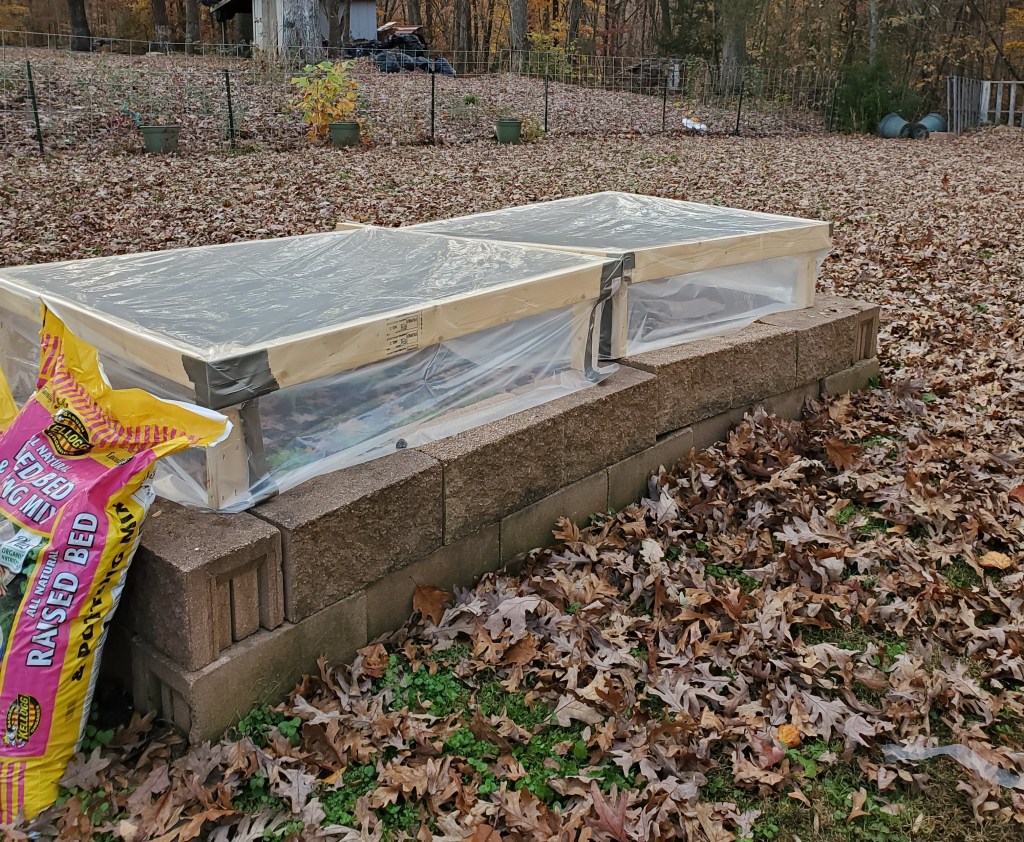
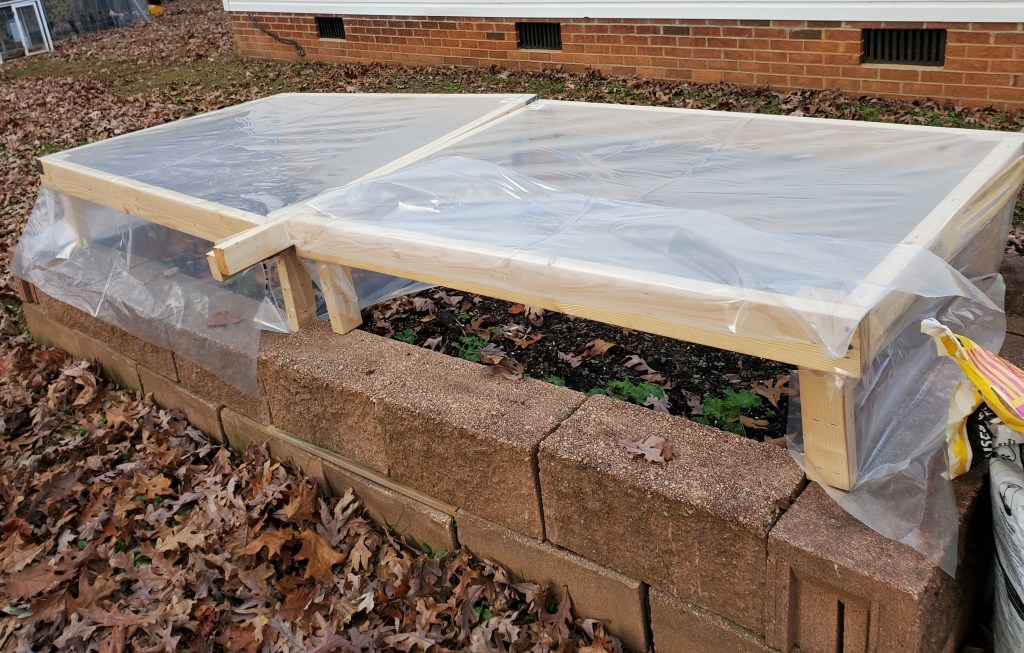
Previously we got the coop extension covered and the ends of the greenhouse closed in.
I had intended to put the rooster back in the coop with the girls but every time we tried he picked on Miss Piggy. So, he goes in the coop after dark (chickens are semi-comatose in the dark) and is removed back to his bachelor pad (the little coop) in the morning.
The fall garden is doing well. We’ve harvested the last of the peppers, two cuttings of lettuce, and quite a few radishes so far.
Short Term Food Storage vs Long Term Food Storage
THE HISTORY OF FOOD STORAGE
In the olden days, when I was first introduced to Food Storage (in the 1970’s), we were instructed to store a one year’s supply of wheat, beans, milk, and salt for each member of our family. These foods provide nearly complete nutrition and can be stored for long periods of time (30 years or more when packaged and stored properly).
In truth, it was an onerous task. That was an enormous amount of food and it didn’t come in pre-packed #10 cans like you can get from a dozen places these days. We used dry ice to pack it in buckets. Nevertheless, we did the best we could within our individual circumstances. Most of the time, unfortunately, people treated it as a task to check off: they got their food storage, packaged it, found a place to put it, and let it sit (sometimes for decades).
Of course, it was intended that you eat this stuff and keep it rotated by adding new supplies as you used them. We had classes on how to make bread, use beans, how to make powdered milk more palatable, and learned to make cereal and “meat” out of wheat. We even learned how to sprout wheat to provide greens in our diet. Even then, though, the grocery store was already taking over and most of us just didn’t eat that way. To complicate things further, more and more women were entering the workforce and cooking that way just took too much time.
We got smarter through the years and found a different way to follow the adage “Store what you eat and eat what you store”. Those four basics are great, and we still need to include them in our Long Term Food Storage (and incorporate them into our families’ diets). With the advent of food storage companies who provided freeze-dried and dehydrated fruits, vegetables, meat, and other foods in #10 cans for long-term storage, we were able to store food with improved variety and nutrition. Still many people just collected their food storage and didn’t use it.
That’s when the concept of Short Term Food Storage was introduced.
WHAT IS SHORT TERM FOOD STORAGE?
Short Term Food Storage involves gathering a 3-month supply of foods that your family eats every day. These are foods that you eat and rotate through on a regular basis.
Short Term Food Storage is intended to get us through a short term crisis. Each of us has likely had to weather issues from illness, job loss, food shortages, natural disasters, etc. With a three month supply of food, regardless of what is going wrong, you will still be able to put familiar foods on the table every day.
Short Term Food Storage will include things like canned fruits, vegetable, soups, meats, and pasta sauces; condiments; peanut butter and jam/jelly; cold and hot cereals; snacks like chips, crackers, cookies, fruit snacks; baking mixes for pancakes, muffins, cookies; pantry basics like flour, sugar, pasta, rice, salt, cooking oil/shortening, spices; boxed meal items like mac and cheese, ramen, hamburger helper. The food in your freezer is also part of your Short Term Storage.
The beauty of Short Term Food Storage is that it is fully customizable, allowing each household to adapt their food storage to special diets (gluten-free, dairy-free, keto, etc.), babies, pets, changing family size. It also allows you to adapt to changes in how and what you cook from one period of your life to another.
The weakness of Short Term Food Storage is that these kinds of foods can only be stored for a few months to 2 or 3 years. That is why we need to have both Short Term Food Storage and Long Term Food Storage.
##########
I have been grateful to have gained experience with having a food storage over many years and I have relied on it to sustain my family. I enjoy finding new ways to make it work for me and have learned new skills that have continued to be useful. I hope what I post on this Food Storage page will be helpful to others seeking better food security for their families.
 Two Chickens Homestead
You must be logged in to post a comment.