WHAT DID WE LEARN? – EMERGENCY SCENARIO #1
What are some of the lessons you learned from participating in Emergency Scenario #1?
“A train derailment caused hazardous material to spill into your local water source and it is contaminated. You are unable to use the water from your faucet.”
When you practiced this, did you take the following into consideration?
- You would have had to shut off the main water line to your house so that the contaminated water doesn’t reach your pipes. Do you know how to do that?
- You can only drink your stored water today. Do you have alternate sources of hydration (juice, etc)?
- You must cook all of your meals using your stored water. How will you adapt your meal plan?
- You can use your toilets but since your water is shut off you must flush with stored water.
- You must take a shower or bath using stored water
- How will you do your laundry?
- How will you wash the dishes?
Here were some of the comments I encountered from other participants at Food Storage Made Easy:
Kathy said this no water situation happens frequently in her neighborhood. When the power goes out, there is no power for the pumps on the community wells, so she gets lots of practice with this type of event.
Several people felt this wasn’t a problem for them as they were on wells or springs. Don’t get caught up in the specifics of the scenario. Ground water / well water gets contaminated too. As new developments and businesses are built in rural areas the water source for your well can be effected – and not in a good way. Your well should be periodically tested by the county.
Several people said they would flunk this exercise. They had little or no water storage.
Several others felt they were well prepared as they kept more than the 3-gallons per person suggested for your 72-hour kit.
Carmel had 7 fifty-five gallon barrels and 10 one-gallon jugs for a household of three. One thing to remember if you use large barrels for water storage: you need a pump to get it back out.
Nancy noted that her WaterBob (a liner for the bathtub to use for water storage) was only good if you had notice of an impending challenge (like a hurricane). In this scenario, that would not be an option.
Teri noted that she keeps water in her RV parked on her property that will provide 150 gallons. What are some other out-of-the-box storage ideas you can think of?
Teri also has a wash tub system for handwashing clothes (very expensive from Lehman’s).
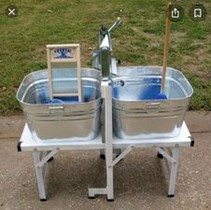
Less expensive laundry options are available on Amazon that might be better for a short-term water emergency situation.
Milenda said she found out she could still use her washer with the water intake turned off. She still had to pour water into the washer and run it through the wash and drain cycle, add more water for the rinse / drain / spin cycle. Is this feature available on your washer? Do you have sufficient water storage to do it?
Proper hygiene is a priority any time but it becomes a heightened matter when water is scarce.
Some people suggested using baby wipes or Wet Ones for hand washing. In an practice session a family friend did about ten years ago, they found that filling a spray bottle with water and small amount of soap allowed them to keep their and the children’s hands clean to ensure germ control without using large amounts of water as we do when the faucet is running.
Several people commented on the “refreshing” chill and how they had to adapt their bathing routine to use as little water as possible.
Many felt they had the drinking water covered but were lacking in the hygiene needs, especially for flushing the toilet. Do you even know how much water it takes to flush your toilet?
That’s enough from me. It’s your turn to chime in. What did you learn? Where are your weak points? What are you going to do to resolve them?
Everyone’s situation is different and how the problem is addressed may not look the same from one household to another. The important thing is that we take the counsel to STORE WATER seriously.
Leave a comment and help us all learn from your experience with this water challenge.
 Two Chickens Homestead
You must be logged in to post a comment.